
Blog
What Is a Bespoke Suit? Meaning, History and How It Is Made

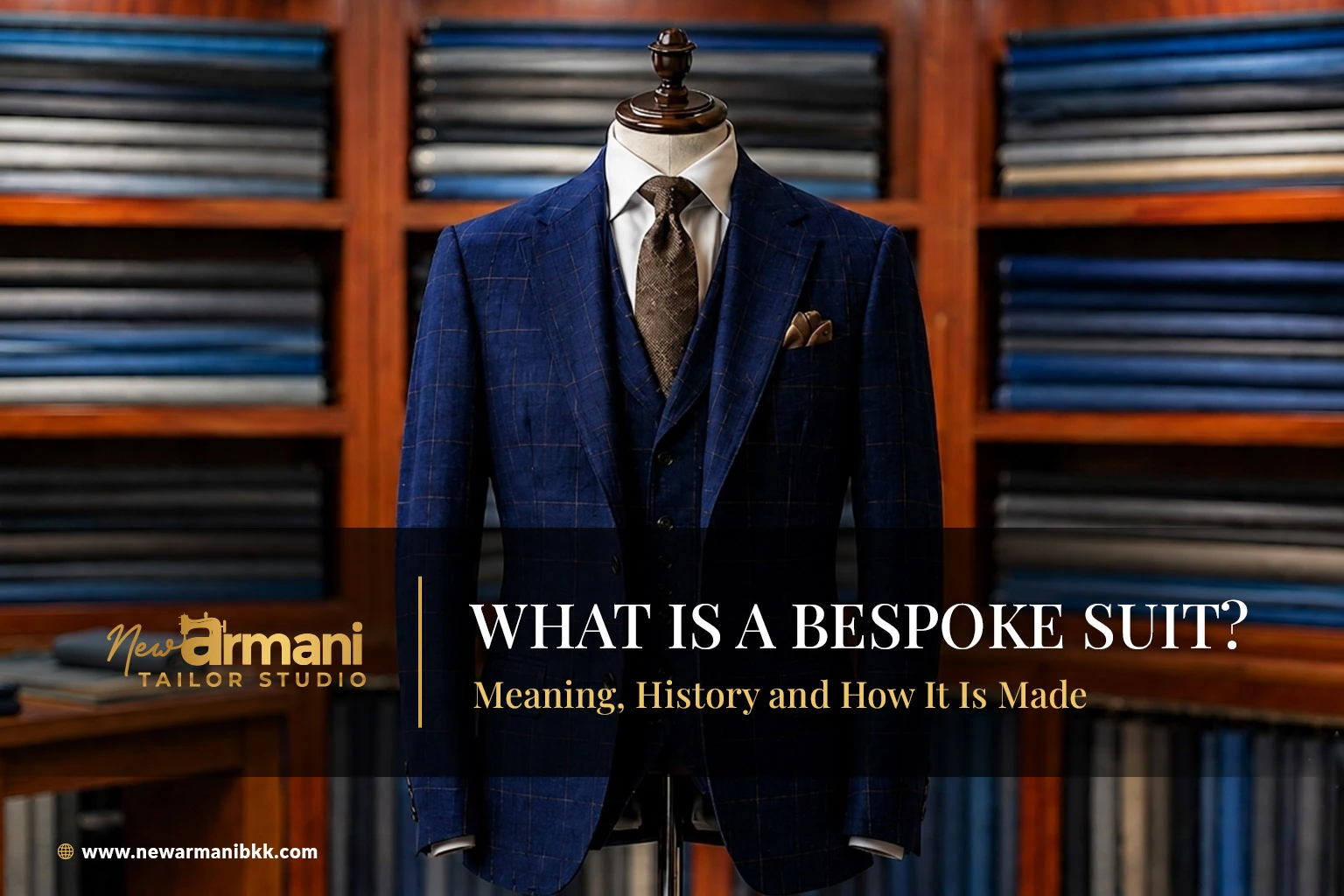
The word bespoke is used widely in modern fashion, especially when talking about suits, shirts and other individually made garments.
But what is a bespoke suit in its traditional sense?
A bespoke suit is created specifically for the individual who will wear it. Instead of beginning with a finished garment in a standard size, the tailoring process begins with the customer’s measurements, body proportions, preferred fit, fabric and design choices.
Traditionally, this may also involve creating an individual pattern and refining the garment through fittings before it is completed.
The idea behind bespoke tailoring is simple:
The garment is created around the wearer, rather than asking the wearer to fit into an existing garment.
At New Armani Tailor Studio, we work with customers looking for something more personal than an off-the-rack suit. Understanding what bespoke means, how it developed and how the tailoring process works can help you make a more informed decision when ordering a custom suit.
Table of Contents
What Does “Bespoke” Mean?
The word bespoke comes from the verb bespeak.
Historically, bespeak developed a meaning connected with ordering something in advance. The word bespoke later became associated with items made specifically for a particular customer.
In tailoring, the concept is straightforward:
The clothing is made for a particular person rather than produced first and then matched to a customer.
Today, however, the term is used more broadly across the fashion industry. Different tailors may use different methods, which is why understanding the actual tailoring process is more useful than relying on the word “bespoke” alone.
A Brief History of Bespoke Tailoring
Bespoke tailoring did not appear at one specific moment or from one particular tailoring house.
Its development was part of a much broader evolution in men’s clothing.
During the 18th and 19th centuries, European menswear gradually moved away from some of the highly decorative styles associated with earlier formal dress. Greater attention began to be placed on cut, proportion, shape and the way clothing followed the body. Surviving garments from the period show increasingly precise tailoring and growing attention to silhouette.
That shift helped create the foundation for the tailored suit we recognise today.
From Decorative Clothing to Tailored Shape
Earlier men’s clothing often relied heavily on elaborate fabrics, embroidery and decorative details.
As tailoring developed, the cut of the garment itself became increasingly important.
Tailors learned to use seams, shaping, pressing and careful construction to influence how clothing sat on the body.
Instead of decoration doing most of the visual work, fit and proportion became increasingly important parts of men’s style. The Metropolitan Museum of Art notes that late-18th-century tailoring was already showing careful shaping that anticipated the greater emphasis on cut seen during the 19th century.
The Development of the Modern Suit
The modern suit also evolved gradually rather than appearing in its present form overnight.
By the early 19th century, matching garments were becoming increasingly common, while long trousers were replacing knee breeches for everyday wear.
Over time, the familiar combination of:
- Jacket
- Waistcoat
- Trousers
developed into the foundation of the modern three-piece suit.
Styles continued to evolve. Jacket lengths changed, trousers became wider or narrower, lapels shifted in proportion and different tailoring traditions developed their own approaches to structure and silhouette.
But one principle remained important:
Good tailoring depends on the relationship between cloth, cut and the person wearing the garment.
The Role of Savile Row
Savile Row deserves a place in the history of bespoke tailoring, but it is one important chapter rather than the entire story.
The London district became particularly associated with high-quality men’s tailoring during the 19th century. Tailors in and around Savile Row developed an international reputation for individually made garments, specialist craftsmanship and fitting-based tailoring. London Museum describes the area as an important centre of men’s tailoring from the mid-1800s onward.
Its influence helped establish many of the traditions that people continue to associate with classic British bespoke tailoring today.
However, bespoke and custom tailoring are no longer limited to London.
Bespoke Tailoring Around the World
As international travel, textile production and fashion expanded, personalised tailoring developed in many different parts of the world.
Today, tailoring traditions can be found across Europe, Asia, North America and other regions, often reflecting different climates, styles, construction methods and customer expectations.
Italian tailoring, for example, may favour a different silhouette from traditional British tailoring. Tailoring in warmer destinations may place greater emphasis on lightweight fabrics and breathable construction. The methods may vary, but the central idea of individually fitted clothing continues.
And that brings us to the most important question:

What Makes a Suit Truly Bespoke?
Not every suit made from measurements is created in the same way.
Traditional bespoke tailoring generally involves a much greater level of individualisation than purchasing a standard-sized garment. The exact methods can differ between tailoring houses, but several characteristics are commonly associated with the bespoke process.
1. An Individual Pattern
Traditionally, the tailor creates a pattern specifically for the customer. It is not simply a standard size adjusted from a factory template.
The pattern can account for things such as:
- Shoulder slope
- Posture
- Chest shape
- Waist position
- Hip position
- Arm position
- Jacket length
- Trouser balance
- Differences between the left and right sides of the body
2. Detailed Measurements
Measurements are the starting point, but good tailoring involves more than recording numbers. Two people can have the same chest measurement and still require very different jackets.
One may have:
- A lower right shoulder
- A forward posture
- A fuller chest
- A straighter waist
- Longer arms
The other may have completely different proportions. A tailor therefore looks not only at how large the body is, but also at how the body is shaped.
3. Fabric Chosen for the Individual
Fabric affects much more than colour.
It influences:
- Drape
- Structure
- Breathability
- Weight
- Durability
- Formality
- Comfort
A business traveller may need something very different from a groom preparing for an evening wedding. This is one reason fabric consultation matters.
4. A Basted or Preliminary Fitting
In traditional bespoke tailoring, the garment is assembled in an unfinished state before final construction. This allows the tailor to see how it actually sits on the client's body.
At this stage, the tailor can evaluate:
- Shoulder position
- Jacket balance
- Chest shape
- Waist suppression
- Sleeve direction
- Jacket length
- Trouser line
Adjustments can then be made before the garment is completed.
5. Multiple Fittings
One of the most valuable parts of bespoke tailoring is the opportunity to evaluate the garment while it is being made.
Measurements provide numbers, but a fitting shows how the garment actually behaves on the body.
During a fitting, the tailor can examine:
- How the collar sits against the neck
- Shoulder position
- Jacket balance
- Chest comfort
- Waist shape
- Sleeve direction
- Trouser line
- Overall movement
Adjustments can then be made to improve the fit before the garment is completed. The number and type of fittings can vary depending on the tailor, garment and production method.
6. Handwork & Construction
Traditional bespoke is labour-intensive.
The cloth may be shaped through cutting, pressing, stitching and other specialist techniques. Note that craftspeople have to spend years training in specialist areas of tailoring.
This is one reason traditional bespoke garments can take considerably longer than ordinary custom or made-to-measure clothing.
Bespoke vs Made-to-Measure: What Is the Difference?
These terms are often confused. The simplest distinction is the starting point.
| Bespoke | Made-to-Measure |
|---|---|
| Traditionally begins with an individual pattern | Begins with an existing base pattern |
| Pattern created around one client | Standard pattern adjusted |
| Greater freedom to change proportions | Changes usually work within an existing system |
| Traditionally includes several fittings | Often requires fewer fittings |
| High level of individualisation | High level of customisation |
| Usually more labour intensive | Usually faster to produce |
The biggest distinction is the starting point. Traditional bespoke tailoring develops the garment around the individual, while made-to-measure typically adapts an existing pattern or sizing system to the customer’s measurements.
Neither approach automatically guarantees a better-looking suit. The final result still depends on the quality of the measurements, fitting, construction and the skill of the people making the garment.
Bespoke vs Off-the-Rack Suits
The biggest difference is where the tailoring process begins.
Off-the-Rack Suit
An off-the-rack suit is already produced before you enter the store. You choose from predetermined sizes such as 38R, 40R or 42L.
Alterations can then be made to improve the fit.
Bespoke Suit
Bespoke tailoring works in the opposite direction. The process begins with the person who will wear the suit.
Measurements are taken first, followed by the creation and refinement of the garment around the individual.
That difference is at the heart of bespoke tailoring. Instead of adjusting an existing garment to the customer, the garment is created around the customer from the beginning.
Does Bespoke Always Mean Handmade?
Not necessarily.
This is where modern terminology becomes less clear.
The word “bespoke” is now used much more widely than it was historically. Different tailoring businesses may use different combinations of handwork, machines, digital patterns and traditional techniques.
That means customers should ask exactly what a tailoring house means when it uses the word.
Useful questions include:
- Is an individual pattern created?
- How many fittings are included?
- Is there a basted fitting?
- How is the jacket constructed?
- What parts are completed by hand?
- Are my measurements or pattern kept for future orders?
This is a much better way to evaluate a tailor than relying on the word “bespoke” alone.
Why Does a Bespoke Suit Fit Differently?
A good bespoke suit does not simply make clothing tighter. It tries to create balance.
For example, one shoulder may naturally sit lower than the other. A jacket made from a standard symmetrical pattern may make that difference more visible.
A tailor can adjust the garment to create a more balanced appearance.
The same applies to:
- Forward shoulders
- Uneven hips
- Different arm positions
- Prominent shoulder blades
- Fuller chest or stomach
- Long or short torso
- Different leg proportions
- That is why fitting involves observation as well as measurement.

What Can You Personalise on a Bespoke Suit?
One of the attractions of bespoke tailoring is choice.
Depending on the tailor, clients may select elements such as:
Fabric
Wool, linen, cotton and different blends can suit different climates and occasions.
Lapel
Common options include:
- Notch lapel
- Peak lapel
- Shawl lapel
Jacket Style
Choose between:
- Single-breasted
- Double-breasted
- Two-piece
- Three-piece
Button
Buttons can change the character of the garment more than many people expect.
Lining
A lining can remain understated or add a more personal touch inside the jacket.
Flap, jetted and patch pockets can all change the level of formality.
Trousers
Choices may include:
- Pleated or flat-front
- Side adjusters or belt loops
- Cuffs or plain hems
- Higher or lower rise
The goal is not to add every available option. Good tailoring means choosing details that work together.
Which Fabric Is Best for a Bespoke Suit?
There is no single best fabric.
The right choice depends on where and how you will wear the suit.
1. Business
Worsted wool remains versatile because it holds its shape and works across many professional settings.
2. Wedding
The choice depends on the venue, weather and formality. Wool, lightweight blends and linen can all work depending on the event.
3. Black Tie
Formal eveningwear traditionally calls for a more refined fabric and appropriate tuxedo details.
4. Warm Weather
Linen and lightweight wool can provide greater breathability.
New Armani Tailor Studio currently carries more than 1,000 fabrics, including wool, linen, cotton shirting and other options for different garments and climates.
How Long Does a Bespoke Suit Take?
There is no universal answer.
A traditional bespoke process is deliberately slow because of the pattern work, hand construction and multiple fittings involved.
Other tailoring markets work differently.
Bangkok, for example, has developed a tailoring industry that often operates around international travellers with limited time.
New Armani Tailor Studio standard custom production can take approximately 2–4 days with one to two fittings, while selected Fast Track orders may be possible within 48 hours, depending on the order and schedule.
Note For travellers: Always share your departure date before ordering. More time allows more opportunity for fitting and adjustment.
How Bespoke and Custom Tailoring Developed in Bangkok
As personalised tailoring became increasingly international, different tailoring centres developed around the world.
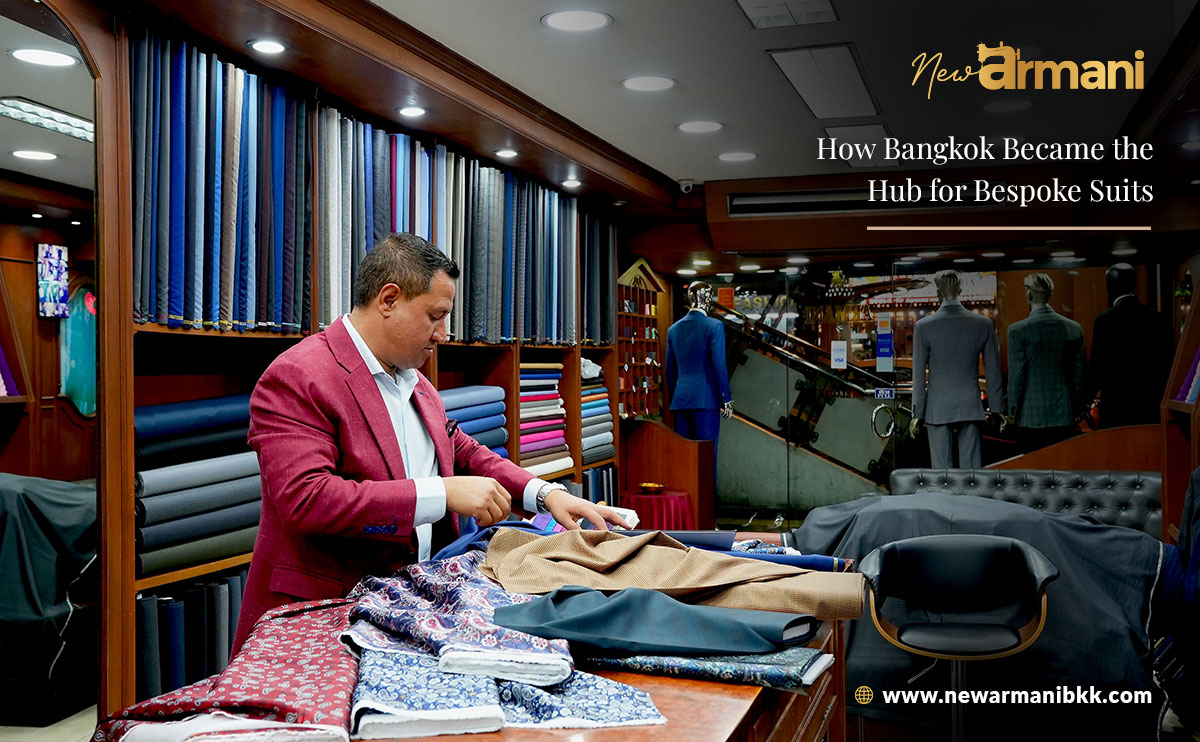
Bangkok became particularly well known among international travellers looking for custom-made clothing during business trips and holidays. The city’s tailoring industry developed around customers who often needed to select fabrics, complete measurements, attend fittings and receive their finished garments within a relatively limited stay.
Today, Sukhumvit and other parts of Bangkok are home to tailoring studios serving international visitors, professionals, wedding customers and local residents.
New Armani Tailor Studio has operated in Bangkok since 2006 and is located on Sukhumvit Road near BTS Nana. Its tailoring service includes fabric consultation, detailed measurements and scheduled fittings.
The New Armani Tailor Studio Approach
At New Armani Tailor Studio, we believe that the most important part of custom tailoring is understanding the person who will actually wear the garment.
That starts with the occasion.
- Is the suit for work?
- A wedding?
- A black-tie event?
- Travel?
- Or simply a wardrobe that fits better?
From there, we discuss the fabric, style and preferred fit before taking measurements.
Customers can choose from more than 1,000 fabrics and personalise details such as the lapel, lining, buttons and trouser style.
Our Bangkok service also reflects the needs of international travellers.
On-location measurements and fittings may be arranged at selected Bangkok hotels or residences. Complimentary hotel pickup may also be arranged in advance.
The important point is not to rush every customer into the same suit. The garment should make sense for the person's body, lifestyle and occasion.
Let’s Create a Suit That Fits Your Life
Tell us about your occasion, style and preferred fit. Our tailoring team will help you explore suitable fabrics and create a suit designed around you.
Does a Bespoke Suit Last Longer?
It can, but the word “bespoke” by itself does not guarantee durability.
How long a suit lasts depends on:
- Fabric
- Construction
- Frequency of wear
- Fit
- Care
- Rotation between garments
A beautifully fitted suit worn five days every week without rest may wear faster than several suits rotated properly.
Fabric should therefore be chosen according to real use rather than appearance alone. A business traveller may benefit from a harder-wearing wool.
Someone buying a suit for occasional weddings can make a different choice.
How to Choose a Bespoke Tailor
The word on the shopfront should not be your only deciding factor. Ask about the actual process. A good consultation should explain:
Measurements
How will your posture and proportions be evaluated?
Fabric
What exactly are you buying?
Construction
How will the jacket be made?
Fittings
How many opportunities will there be to adjust the garment?
Timeline
Will there be enough time for alterations?
Price
What is the cost of bespoke suit?
Bespoke Tailoring Is Really About the Individual
The history of bespoke tailoring is filled with famous streets, skilled craftspeople and traditions passed between generations.
But its central idea is surprisingly simple. Clothing should be shaped around the wearer.
That principle helped transform men's dress during the 18th and 19th centuries. It shaped Savile Row's reputation. It continues to influence modern tailoring around the world.
Styles will continue to change.
Lapels will become wider and narrower.
Trousers will rise and fall.
Colours will move in and out of fashion.
But the relationship between body, cloth and cut remains at the centre of good tailoring.
Experience Bespoke Tailoring in Bangkok
At New Armani Tailor Studio, our team helps clients create suits for business, weddings, formal events and everyday professional wear.
Visit our studio near BTS Nana Exit 4 to explore fabrics, discuss your preferred fit and plan your custom garment. New Armani has been creating custom clothing in Bangkok since 2006.
Ready to Create a Suit Made Around You?
Discuss your style, occasion and preferred fit with our tailoring team.
Frequently Asked Questions About Bespoke Suits
What is a bespoke suit?
A bespoke suit is made specifically for an individual customer. In the traditional definition, an individual pattern is created and the garment is refined through multiple fittings.
What does the word bespoke mean?
“Bespoke” comes from bespeak, a word historically associated with requesting or reserving something in advance. It later became strongly associated with goods made for a particular customer.
Where did bespoke tailoring originate?
Modern bespoke tailoring is strongly associated with London’s Savile Row, which became an important centre for specialist suit makers during the 19th century.
How many fittings does a bespoke suit need?
Traditional bespoke normally involves several fittings. The exact number depends on the tailor, garment and amount of adjustment required.
Is bespoke better than made-to-measure?
Not automatically. Bespoke provides greater potential for individual pattern work and fitting adjustments, but quality still depends on the tailor, construction and execution.

About James Artre
James Artre owner of New Armani Tailor Studio and has more than 20 years of experience in bespoke tailoring.
View all posts by James Artre



One thought on “What Is a Bespoke Suit? Meaning, History and How It Is Made”